

- Afrikaans
- العربية
- Azərbaycanca
- Български
- বাংলা
- Bosanski
- Беларуская
- Català
- Čeština
- Dansk
- Deutsch
- Ελληνικά
- English (AU)
- Español
- Eesti
- Euskara
- Français
- Galego
- ગુજરાતી
- עברית
- हिन्दी
- Hrvatski
- Bahasa Indonesia
- Íslenska
- Italiano
- 日本語
- Kartuli
- ಕನ್ನಡ
- 한국어
- Kurdî
- Lëtzebuergesch
- Lietuviškai
- Latviešu
- Bahasa Melayu
- Malti
- မြန်မာဘာသာ
- Nederlands
- Norsk
- Polski
- Português
- Română
- Русский
- Albanian
- Српски
- ภาษาไทย
- Tiếng Việt
- 汉语
- Afrikaans
- العربية
- Azərbaycanca
- Български
- বাংলা
- Bosanski
- Беларуская
- Català
- Čeština
- Dansk
- Deutsch
- Ελληνικά
- English (AU)
- Español
- Eesti
- Euskara
- Français
- Galego
- ગુજરાતી
- עברית
- हिन्दी
- Hrvatski
- Bahasa Indonesia
- Íslenska
- Italiano
- 日本語
- Kartuli
- ಕನ್ನಡ
- 한국어
- Kurdî
- Lëtzebuergesch
- Lietuviškai
- Latviešu
- Bahasa Melayu
- Malti
- မြန်မာဘာသာ
- Nederlands
- Norsk
- Polski
- Português
- Română
- Русский
- Albanian
- Српски
- ภาษาไทย
- Tiếng Việt
- 汉语
Damper: The Bread That Survives Everything
A humble bush bread, a story of survival, and why simple food still matters in Conspiracy at World’s End.
CONSPIRACY AT WORLD'S END
Daz James
3/22/20265 min read
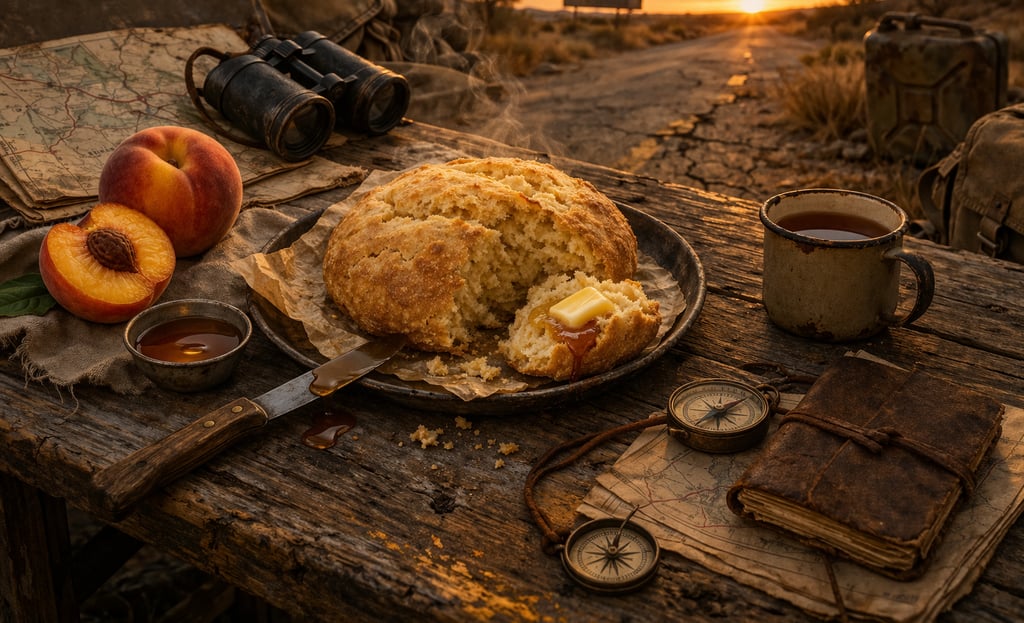
There are some foods that belong to a place. Not in a complicated, gourmet sense, but in a quiet, enduring way. The kind of food that doesn’t need reinvention or explanation, it just exists, passed from hand to hand, generation to generation.
In Australia, damper is one of those foods. It’s simple. Almost stubbornly so. Flour, water, a pinch of salt. Maybe a little butter if you’re feeling generous. That’s it.
And yet, somehow, it carries history, culture, survival, and, perhaps unexpectedly, a sense of comfort. Which is exactly why it found its way into Conspiracy at World’s End.
What Is Damper?
At its core, damper is bush bread. Traditionally made by stockmen, drovers, and swagmen travelling through the Australian outback, it was designed to be as practical as possible. No yeast. No long preparation. No specialised equipment.
Just a fire, a bit of time, and the simplest ingredients imaginable.
The dough is usually wrapped around a stick or placed directly into the coals of a campfire, where it bakes into a dense, slightly crumbly loaf with a crisp outer crust. Note: You can also wrap it in foil.
It’s not fancy. It’s not delicate. But it works. And sometimes, that’s exactly what you need.
A Brief History (Without Turning This Into a Lecture)
Damper has its roots in both Indigenous Australian food traditions and European settler cooking.
Long before colonisation, First Nations Australians were already making forms of bush bread using native grains, ground seeds, and water, cooked in the ashes of a fire. These methods were practical, efficient, and deeply connected to the land.
When European settlers arrived, they adapted their own bread-making traditions to the harsh conditions of the Australian interior. Without access to ovens or consistent supplies, they leaned into simplicity.
Flour, water, and fire became the foundation. The result was damper, a food born out of necessity, shaped by environment, and sustained by ingenuity. It wasn’t meant to be celebrated. It was meant to keep people going.
The Beauty of Simplicity
There’s something quietly reassuring about a food that hasn’t changed much. In a world full of options, variations, and endless reinvention, damper stays the same. It doesn’t need embellishment. It doesn’t try to be anything other than what it is.
That simplicity is part of its appeal. It’s also part of its symbolism.
In Conspiracy at World’s End, food is not about luxury. It’s about survival, connection, and small moments of normality in a world that has lost most of its comforts.
Damper fits perfectly into that space. It’s reliable. It’s filling. And it asks very little in return.
How to Make Damper (Yes, You Can Actually Try This)
If you’ve never made damper before, you might be surprised at how straightforward it is. Here’s a simple version you can make at home. No outback required.
Ingredients:
3 cups self-raising flour
1 teaspoon salt
1 tablespoon butter (optional, but recommended)
1 to 1½ cups water or milk
Method:
Preheat your oven to around 200°C (or prepare a campfire if you’re feeling adventurous).
Mix the flour and salt in a bowl.
Rub in the butter until the mixture resembles breadcrumbs.
Gradually add liquid until it forms a soft dough.
Shape into a round loaf and place on a baking tray (or wrap in foil for coals).
Bake for about 30–40 minutes, until golden and hollow-sounding when tapped.
That’s it. No kneading marathons. No waiting for dough to rise. No existential crisis about whether you’ve killed your yeast. Just bread.
The Many Ways to Eat It
Now, here’s where things get interesting. Damper may be simple, but how people eat it can vary wildly.
The traditional approach is to tear it apart while it’s still warm and spread it generously with butter. Golden syrup is a popular addition, soaking into the crumb and turning something basic into something almost indulgent.
Others prefer jam.
Some go savoury, pairing damper with stews, soups, or whatever else happens to be available.
And then there are the more modern variations: cheese damper, herb-infused versions, even sweet adaptations with dried fruit mixed into the dough.
Purists may raise an eyebrow at these variations. But that’s part of the fun. Damper evolves depending on who’s making it and what they have on hand.
Which, if you think about it, is exactly how it started.
Cooking It the “Proper” Way
While oven-baked damper is convenient, there’s something undeniably satisfying about cooking it over an open fire.
Traditionally, damper would be placed directly into the ashes or wrapped around a stick and held over the flames. The outside would char slightly, forming a crust, while the inside cooked into a dense, hearty loaf.
It’s not the most precise method. Sometimes it burns. Sometimes it’s undercooked in the middle. But when it works, it really works.
And more importantly, it turns cooking into an experience rather than a process. There’s something about sitting around a fire, waiting for bread to cook, that feels timeless.
Note: Perfect for camping. Just remember to pack the tin foil.
Damper and Storytelling
Food has always been part of storytelling. Not just as background detail, but as something that reveals character, culture, and connection.
In Conspiracy at World’s End, damper appears not as a focal point, but as part of the texture of the world, one of those small details that make the environment feel lived-in.
It’s the kind of food people would realistically rely on. Something they can make with limited resources. Something that doesn’t require complicated tools or rare ingredients. And something that, despite its simplicity, still offers a sense of comfort.
Because even in difficult circumstances, people don’t just want to survive. They want to feel human.
The Comfort of Something Familiar
There’s a reason simple foods often carry the strongest emotional weight. They remind us of home. Of routine. Of times when things felt stable and predictable.
Damper, in its own quiet way, does that. It’s not flashy or memorable in the way a complex dish might be. But that’s not the point. Its value lies in its consistency.
In a world that feels uncertain, something consistent becomes incredibly important. Even something as simple as bread.
Why Damper Still Matters
You might be wondering why a humble loaf of bush bread deserves this much attention. The answer is simple: because it represents something bigger than itself.
Damper is about resourcefulness. It’s about making something out of very little. It’s about adapting to circumstances and finding ways to keep going. And in a story like Conspiracy at World’s End, those ideas matter.
The world of the book isn’t built on abundance. It’s built on resilience. And sometimes resilience looks like grand acts of courage.
But sometimes, it looks like mixing flour and water and baking it over a fire.
A Final Thought (and Possibly an Excuse to Bake)
If you’ve never tried damper, this might be your sign. Not because it will change your life in a dramatic, cinematic way. But it offers something simple, grounding, and quietly satisfying.
And in a world that often feels complicated, that’s not a bad thing. Plus, if nothing else, you’ll end up with fresh bread. And that’s rarely a mistake.
#postapocalypticfiction #writingcommunity #australianwriting #foodandstory #indieauthor #ConspiracyAtWorldsEnd

Daz James
Promote published works, interact with readers, share updates.
© 2024. All rights reserved.