

- Afrikaans
- العربية
- Azərbaycanca
- Български
- বাংলা
- Bosanski
- Беларуская
- Català
- Čeština
- Dansk
- Deutsch
- Ελληνικά
- English (AU)
- Español
- Eesti
- Euskara
- Français
- Galego
- ગુજરાતી
- עברית
- हिन्दी
- Hrvatski
- Bahasa Indonesia
- Íslenska
- Italiano
- 日本語
- Kartuli
- ಕನ್ನಡ
- 한국어
- Kurdî
- Lëtzebuergesch
- Lietuviškai
- Latviešu
- Bahasa Melayu
- Malti
- မြန်မာဘာသာ
- Nederlands
- Norsk
- Polski
- Português
- Română
- Русский
- Albanian
- Српски
- ภาษาไทย
- Tiếng Việt
- 汉语
- Afrikaans
- العربية
- Azərbaycanca
- Български
- বাংলা
- Bosanski
- Беларуская
- Català
- Čeština
- Dansk
- Deutsch
- Ελληνικά
- English (AU)
- Español
- Eesti
- Euskara
- Français
- Galego
- ગુજરાતી
- עברית
- हिन्दी
- Hrvatski
- Bahasa Indonesia
- Íslenska
- Italiano
- 日本語
- Kartuli
- ಕನ್ನಡ
- 한국어
- Kurdî
- Lëtzebuergesch
- Lietuviškai
- Latviešu
- Bahasa Melayu
- Malti
- မြန်မာဘာသာ
- Nederlands
- Norsk
- Polski
- Português
- Română
- Русский
- Albanian
- Српски
- ภาษาไทย
- Tiếng Việt
- 汉语
From Fallout Shelters to Flooded Cities
How our dystopian futures have changed.
CONSPIRACY AT WORLD'S END
Daz James
3/15/20265 min read
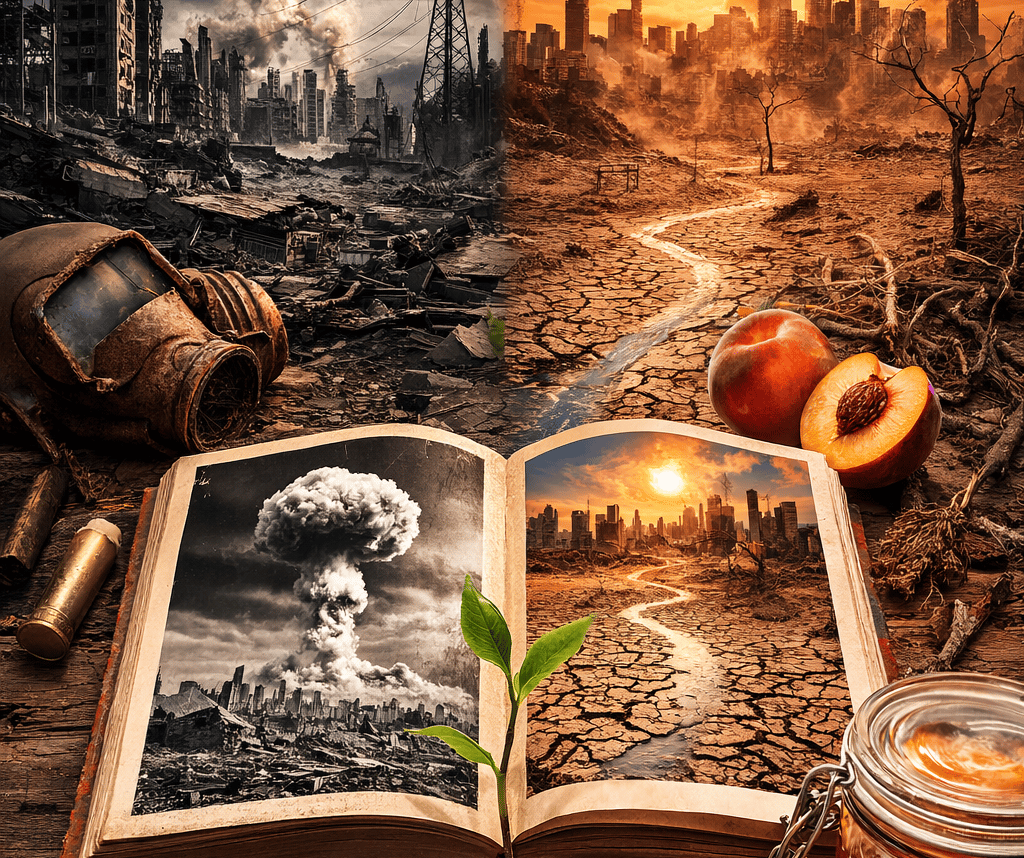
Not so long ago, if you imagined the end of the world, it probably involved a mushroom cloud. For decades, our collective nightmares about the future were shaped by nuclear war. Entire generations grew up with the shadow of atomic weapons hanging over their imagination. The apocalypse, we assumed, would arrive suddenly, in a blinding flash, followed by radioactive dust and silent cities.
Today, however, the stories we tell about the future look very different. In recent years, dystopian fiction has shifted away from nuclear annihilation toward something slower, quieter, and arguably more unsettling: environmental collapse.
In my novel Conspiracy at World’s End, the world that the characters inhabit isn’t defined by a single catastrophic explosion. Instead, it’s the result of gradual environmental changes and the political and social chaos that follows. That shift reflects something much larger happening across modern storytelling.
Our fears about the future have evolved, and fiction has evolved with them.
The Age of the Atomic Apocalypse
To understand the change, we have to go back to the Cold War. In the decades after the atomic bombings of Hiroshima and Nagasaki in 1945, nuclear weapons became the ultimate symbol of human self-destruction. The idea that civilisation could vanish overnight was terrifying — and strangely fascinating.
Writers and filmmakers ran with the concept. The 1959 novel Alas, Babylon by Pat Frank imagined a small American town struggling to survive after nuclear war. Films like The Day After (1983) shocked audiences by showing the devastating human cost of nuclear conflict. Even science fiction classics like Planet of the Apes eventually revealed their ruined worlds to be the aftermath of atomic war.
The message was clear: humanity’s greatest threat was humanity itself.
Even lighter science fiction carried the same underlying anxiety. The Mad Max films, beginning with the original in 1979 and continuing through Mad Max: Fury Road decades later, present a world shaped by resource wars and societal collapse following nuclear conflict.
These stories reflected the fears of their time. When schoolchildren were practicing nuclear drills, and politicians spoke openly about mutually assured destruction, the atomic apocalypse felt like a real possibility.
It made perfect sense that our dystopias looked radioactive.
A Different Kind of End of the World
Fast forward to the 21st century, and the tone of dystopian fiction has shifted dramatically. The threats that dominate our headlines today are different from those that dominated the Cold War. Rising sea levels, extreme weather, drought, biodiversity loss, and environmental instability have replaced nuclear brinkmanship as the looming spectre over our future.
As a result, storytellers have begun imagining apocalypses that unfold slowly rather than instantly. Films like The Day After Tomorrow (2004) depict catastrophic climate events triggered by environmental change. In Snowpiercer (2013), a failed attempt to halt global warming plunges the planet into a frozen wasteland, leaving the remnants of humanity trapped on a constantly moving train.
Television has embraced similar themes. HBO’s The Last of Us presents a world where ecological disruption plays a key role in the spread of a fungal pandemic that collapses civilisation. Even children’s animation occasionally touches on environmental dystopia — Pixar’s WALL-E imagines Earth abandoned after centuries of pollution and overconsumption.
These stories feel different from Cold War nuclear tales. Instead of a sudden blast, the catastrophe creeps in quietly. The apocalypse becomes a process rather than a moment.
The Rise of the Climate Dystopia
Environmental dystopias have become so common that they now have their own nickname: “cli-fi,” short for climate fiction.
Some of the most interesting recent dystopian worlds are shaped by environmental collapse. Margaret Atwood’s MaddAddam trilogy imagines a near future where genetic engineering, ecological destruction, and corporate power combine to dismantle civilisation.
Paolo Bacigalupi’s The Water Knife portrays a drought-ravaged American Southwest where water has become the most valuable commodity on Earth. Even blockbuster franchises have moved in this direction. In Mad Max: Fury Road, water scarcity is as important as violence in shaping the brutal desert society.
These stories resonate because they feel plausible. Unlike nuclear war, which (thankfully) has never occurred on a global scale, environmental change is something people already see happening around them.
Dystopia no longer feels hypothetical. It feels like an extension of the present.
Why Creators Are Changing the Narrative
Creative works often mirror the anxieties of their era. In the 1950s and 1960s, nuclear war dominated political discourse, so it dominated fiction as well. Writers and filmmakers explored the nightmare scenario that seemed most immediate and terrifying.
Today, climate change occupies a similar place in public consciousness. That doesn’t mean nuclear war has disappeared from storytelling entirely, far from it, but environmental collapse offers something that atomic explosions don’t: complexity.
A nuclear war ends the world quickly. Environmental collapse transforms it slowly.
That slower transformation creates rich storytelling opportunities. Writers can explore how societies adapt, how political systems respond, and how individuals navigate a world that is changing piece by piece.
It’s fertile ground for drama, tension, and moral dilemmas.
A World That Feels Uncomfortably Real
Another reason environmental dystopias have become popular is that they feel eerily believable. A radioactive wasteland may feel distant or abstract to many readers today. But drought, wildfires, and rising temperatures are things people experience directly.
When fiction exaggerates those trends, it doesn’t feel like pure fantasy. It feels like a warning.
Stories about climate-driven dystopias often blur the line between speculation and prediction. They ask uncomfortable questions: What happens when resources become scarce? How do governments respond to environmental crises? What happens to communities when the systems they rely on begin to fail?
These questions are not just theoretical anymore. They are already shaping political debates around the world.
The Dystopia of Tomorrow
Of course, dystopian fiction isn’t really about predicting the future. It’s about examining the present.
When writers imagine bleak futures, they’re usually exploring fears, tensions, and possibilities that already exist in the world around them.
The nuclear dystopias of the Cold War reflected anxieties about global conflict and technological power. The climate dystopias of today reflect concerns about environmental sustainability and humanity’s relationship with the planet.
Each era invents the apocalypse that scares it the most.
Where Conspiracy at World’s End Fits In
Conspiracy at World’s End belongs to this newer wave of dystopian storytelling. The world of the novel isn’t defined by radioactive craters or nuclear winter. Instead, it reflects a landscape shaped by environmental change and the fragile societies that emerge in response.
But like all dystopian fiction, the story isn’t really about the end of the world. It’s about people. It’s about how individuals survive, adapt, and search for meaning when everything familiar has been stripped away.
And occasionally, it’s about finding something unexpectedly sweet, even in the middle of chaos. Yes, sometimes that sweetness comes in the form of a peach.
Why We Keep Imagining the End
There’s something strangely comforting about dystopian stories. They allow us to confront our fears from a safe distance. They let us explore worst-case scenarios without actually living through them.
More importantly, they remind us that even in the darkest imagined futures, people still find ways to survive, connect, and rebuild.
The world might change dramatically. Civilisation might stumble. But humanity, stubborn as ever, keeps going.
And perhaps that’s the real reason we keep telling stories about the end of the world. Because deep down, they’re not really about endings at all. They’re about what comes next.
#Futuredistopias #environmentalimpact #ConspiracyAtWorldsEnd #SpeculativeFiction. #Climate #Storytelling #CreativeVision #FutureImagining

Daz James
Promote published works, interact with readers, share updates.
© 2024. All rights reserved.