

- Afrikaans
- العربية
- Azərbaycanca
- Български
- বাংলা
- Bosanski
- Беларуская
- Català
- Čeština
- Dansk
- Deutsch
- Ελληνικά
- English (AU)
- Español
- Eesti
- Euskara
- Français
- Galego
- ગુજરાતી
- עברית
- हिन्दी
- Hrvatski
- Bahasa Indonesia
- Íslenska
- Italiano
- 日本語
- Kartuli
- ಕನ್ನಡ
- 한국어
- Kurdî
- Lëtzebuergesch
- Lietuviškai
- Latviešu
- Bahasa Melayu
- Malti
- မြန်မာဘာသာ
- Nederlands
- Norsk
- Polski
- Português
- Română
- Русский
- Albanian
- Српски
- ภาษาไทย
- Tiếng Việt
- 汉语
- Afrikaans
- العربية
- Azərbaycanca
- Български
- বাংলা
- Bosanski
- Беларуская
- Català
- Čeština
- Dansk
- Deutsch
- Ελληνικά
- English (AU)
- Español
- Eesti
- Euskara
- Français
- Galego
- ગુજરાતી
- עברית
- हिन्दी
- Hrvatski
- Bahasa Indonesia
- Íslenska
- Italiano
- 日本語
- Kartuli
- ಕನ್ನಡ
- 한국어
- Kurdî
- Lëtzebuergesch
- Lietuviškai
- Latviešu
- Bahasa Melayu
- Malti
- မြန်မာဘာသာ
- Nederlands
- Norsk
- Polski
- Português
- Română
- Русский
- Albanian
- Српски
- ภาษาไทย
- Tiếng Việt
- 汉语
Historical Comfort: Small Rituals That Kept People Going
History often feels loud; wars, revolutions, empires rising and falling. But most people survived history not through grand heroics, but through small, repeatable rituals. Lighting candles. Brewing tea. Writing letters. Mending clothes. In this reflective essay, Historical Comfort: Small Rituals That Kept People Going, we explore how ordinary acts created psychological steadiness during uncertain times, and how reclaiming simple daily rituals might support our mental health today.
NOTES FROM THE MARGIN
Daz James
2/20/20265 min read
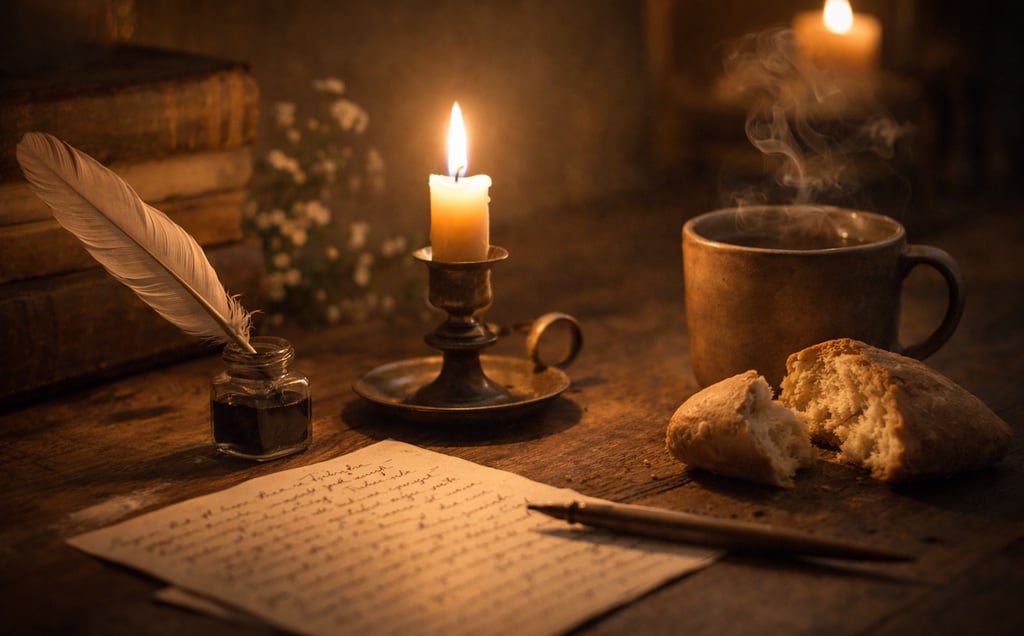
We tend to imagine history as loud. Wars. Revolutions. Speeches. Empires are collapsing dramatically while someone in a powdered wig faints in the background.
But history was mostly quiet. It was someone lighting a candle. It was someone brewing tea. It was someone mending a sleeve by firelight because winter was coming, whether the king behaved or not.
When the world feels unstable, and let’s be honest, it often does, we talk about resilience as if it’s a heroic trait. As if it belongs only to soldiers, activists, and very determined monarchs.
But most resilience throughout history didn’t look like that. It looked like a ritual. Small, repeatable acts that told the nervous system: We are still here. And that might be more relevant now than we realise.
🕯 The Candle in the Window
Before electricity, lighting a candle wasn’t aesthetic. It was survival. But it was also rhythm.
Morning light, evening flame.
Work, rest.
Darkness, glow.
In medieval Europe, households marked the hours through bells and candles. In monasteries, daily prayer wasn’t just devotion; it was structure. During long winters, particularly in northern regions, families gathered around a single light source not just for warmth, but for continuity. Storytelling became a ritual. Repetition became comfort.
When everything outside was uncertain, weather, harvest, politics, the act of lighting that candle remained predictable.
We still light candles now, often instinctively during stress. Power outage? Candle. Hard day? Candle. Bath? Definitely candle. It’s not about wax. It’s about signalling safety.
🍞 Bread as Defiance
During times of rationing, from wartime Britain to Depression-era America, baking became more than sustenance. It became quiet resistance.
In Britain during World War II, “Make Do and Mend” wasn’t just a slogan. It was a psychological anchor. People learned to bake with powdered eggs, stretch ingredients, and swap recipes that worked within limits.
The act of kneading dough, repetitive, physical, and grounded, calms the nervous system. We know this now through modern neuroscience. Rhythmic movement reduces anxiety. Sensory tasks bring us back to the body. But people didn’t need neuroscience to tell them that.
They baked because it gave them something tangible in uncertain times. A loaf rising in the oven was proof that something still worked. Even today, when a crisis hits, people bake. We saw it during lockdowns. Flour vanished from shelves as sourdough starters became unlikely household companions.
It wasn’t about Instagram. It was about control in a world temporarily out of it.
✉ Letters and the Long Wait
Imagine waiting weeks for news. No instant updates. No “last seen 5 minutes ago.” No read receipts to overanalyse at 2 am.
During wars, migrations, and long sea voyages, letters were lifelines. Writing them was a ritual. Receiving them was an event.
People developed routines around correspondence. Sunday was letter writing. Ink was refilled carefully. Paper selected for a purpose. Words chosen with deliberation.
The act of writing, slowly, thoughtfully, is grounding. It requires reflection. It creates narrative from chaos. When you write a letter, you organise experience into a story.
We know from modern psychology that narrative-making supports emotional processing. Trauma becomes more manageable when shaped into language.
People in history did this instinctively. They wrote. They journaled. They recorded. They turned uncertainty into sentences.
🫖 Tea at 4 pm
There is something deeply comforting about a fixed point in the day. In Britain, afternoon tea became a ritual not simply because of etiquette, but because it divided the day. It offered pause. It marked time.
In Japan, the tea ceremony developed into an art form rooted in presence and intention. In Morocco, mint tea signals hospitality and continuity. Across cultures, brewing tea is rarely rushed. It requires waiting. It encourages sitting.
Ritualised pause is psychologically powerful. Modern life tries to erase the pause. Notifications bleed into evenings. Work seeps into weekends. The edges blur.
Historically, rituals created edges.
Morning prayer.
Midday meal.
Evening fire.
Sabbath rest.
These weren’t productivity hacks. They were containment structures for the human mind. And the human mind likes containment.
🧵 Mending, Stitching, Repetition
There’s something quietly profound about mending. In many cultures, repairing clothing was normal. In Japan, kintsugi repaired broken pottery with gold, highlighting cracks rather than hiding them. In households everywhere, socks were darned, buttons replaced, hems resewn.
Repetition calms the nervous system. Handwork slows breathing. Focus narrows gently. We now talk about “mindfulness crafts.” They simply used to be life. Chores for the day.
When the outside world felt unstable, economically, politically, and socially, there was comfort in fixing something small. A sleeve. A pot. A fence.
You couldn’t stop the war. But you could fix the tear. You could make something beautiful once broken. Small acts of repair remind us that not everything is broken beyond help.
🧠 What These Rituals Actually Did
If we strip away the aesthetics and nostalgia, historical rituals did three critical things for mental well-being:
They created predictability.
They anchored people in the body.
They built meaning through repetition.
Predictability lowers anxiety. Embodied tasks reduce rumination. Meaning sustains resilience.
Modern life has many conveniences. It has fewer rituals. We replaced rhythm with constant access. And then we wonder why we feel unmoored.
🌍 Quiet History vs Loud Headlines
History books highlight upheaval. Human survival depended on habit. Someone somewhere always kept sweeping the floor. Someone always brewed something warm. Someone always stitched by lamplight.
That’s how societies actually endure. Not through constant drama but through ordinary continuity. Which might be comforting to remember on days when headlines feel relentless.
🌿 Building Your Own Historical Comfort
This is not about cosplaying medieval peasantry unless that’s your thing. I support niche hobbies. It’s about reclaiming gentle anchors.
Ask yourself:
What is one small act I could repeat daily that signals steadiness?
It could be:
Light a candle before work and take a deep breath
Make a pot of tea the same way each afternoon.
Write three sentences in a notebook about your day
Fold laundry without rushing.
Take a five-minute walk at the same time daily.
Ritual isn’t about grandeur. It’s about return. When you repeat a simple act, you create a thread through time. And threads, woven together, create stability.
✨ The Comfort Was Never Small
We call these “small rituals.” But they weren’t small. They were survival architecture. They held communities together through plagues, wars, depressions, and personal heartbreak.
We romanticise the resilience of past generations. But resilience wasn’t mystical. It was built daily.
Through candles.
Through bread.
Through letters.
Through tea.
Through mending.
Through choosing, again and again, to tend to something small when the big things feel overwhelming. That was their secret.
And here is the real take-home message: you are allowed to do the same. No war, famine or plague required.
🌟 Extension Exercises: Create Your Own Anchor
Here are gentle ways to bring historical comfort into modern life, without turning it into another self-improvement project.
The Repair Practice
Fix something small this week. Sew a button. Clear a drawer. Reattach something loose. Repair creates quiet agency.
A Gentle Reminder
If a ritual ever feels rigid or suffocating, soften it. The goal is steadiness, not control. Rituals should support you, not become another rule to fail.
Closing Thought
History survived not because people were endlessly strong, but because they were gently consistent.
Small acts. Repeated.
You don’t have to hold the whole world together. Just light your candle. Make a pot of tea. And begin there.
#MentalHealth #Wellbeing #SelfCare #Resilience #AnxietySupport #Mindfulness #NervousSystemRegulation #ReflectiveEssay #Ritual #DailyHabits #SimplePleasures

Daz James
Promote published works, interact with readers, share updates.
© 2024. All rights reserved.