
- Afrikaans
- العربية
- Azərbaycanca
- Български
- বাংলা
- Bosanski
- Беларуская
- Català
- Čeština
- Dansk
- Deutsch
- Ελληνικά
- English (AU)
- Español
- Eesti
- Euskara
- Français
- Galego
- ગુજરાતી
- עברית
- हिन्दी
- Hrvatski
- Bahasa Indonesia
- Íslenska
- Italiano
- 日本語
- Kartuli
- ಕನ್ನಡ
- 한국어
- Kurdî
- Lëtzebuergesch
- Lietuviškai
- Latviešu
- Bahasa Melayu
- Malti
- မြန်မာဘာသာ
- Nederlands
- Norsk
- Polski
- Português
- Română
- Русский
- Albanian
- Српски
- ภาษาไทย
- Tiếng Việt
- 汉语
- Afrikaans
- العربية
- Azərbaycanca
- Български
- বাংলা
- Bosanski
- Беларуская
- Català
- Čeština
- Dansk
- Deutsch
- Ελληνικά
- English (AU)
- Español
- Eesti
- Euskara
- Français
- Galego
- ગુજરાતી
- עברית
- हिन्दी
- Hrvatski
- Bahasa Indonesia
- Íslenska
- Italiano
- 日本語
- Kartuli
- ಕನ್ನಡ
- 한국어
- Kurdî
- Lëtzebuergesch
- Lietuviškai
- Latviešu
- Bahasa Melayu
- Malti
- မြန်မာဘာသာ
- Nederlands
- Norsk
- Polski
- Português
- Română
- Русский
- Albanian
- Српски
- ภาษาไทย
- Tiếng Việt
- 汉语
The Romance of the Paper Back
Why we still love a book you can hold.
CONSPIRACY AT WORLD'S END
Daz James
3/27/20265 min read
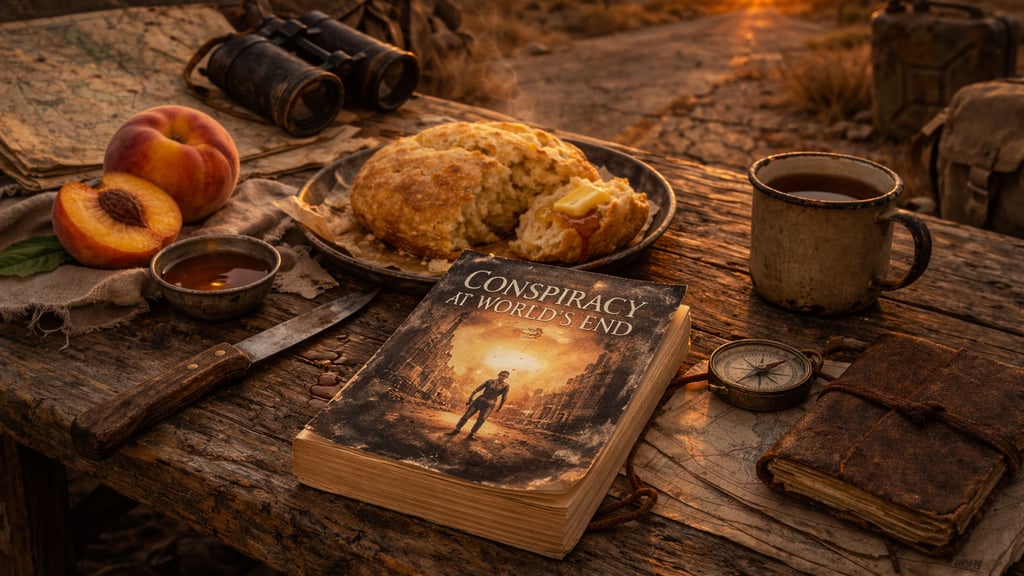
There is something deeply satisfying about holding a book. Not just reading it — holding it. The weight of it in your hands. The quiet resistance of the spine as you open it for the first time. The faint, almost impossible-to-describe smell of paper and ink that seems to carry both history and possibility at once.
In a world where stories are increasingly delivered through screens, taps, and swipes, the physical book remains stubbornly, wonderfully unchanged.
And now, with Conspiracy at World’s End finally available as a paperback, I’ve found myself thinking a lot about why that matters. Because it does. More than we sometimes admit.
A Brief (and Slightly Romanticised) History of the Paperback
Paperback books weren’t always the norm. In fact, for much of publishing history, books were expensive objects. Hardcovers dominated the market — sturdy, formal, and often priced in a way that made them feel like investments rather than everyday items.
Then, in the 1930s, something quietly revolutionary happened. Publishers like Penguin Books in the UK began producing affordable paperback editions — small, portable, and accessible to a much wider audience. Suddenly, literature wasn’t confined to libraries and well-appointed shelves.
It could travel. It could be carried on trains, tucked into bags, read on lunch breaks, and left behind on park benches for someone else to discover. The paperback didn’t just change how books were made. It changed who they were for.
Books That Lived With You
Paperbacks are not pristine objects. They crease. They bend. They collect marks, notes, and the occasional mysterious stain that no one can quite explain. And somehow, that’s part of their appeal.
A well-read paperback tells a story beyond the one printed on its pages. It shows where someone paused. Where they lingered. Where they might have dropped it slightly too enthusiastically into a bag. Made some pencilled notes in the margins or a random name inscribed on the front page.
It becomes personal. Unlike a digital file, which remains the same no matter how many times it’s opened, a physical book changes with use. It carries the memory of being read. It becomes, in a quiet way, a companion.
The Ritual of Reading
There’s also something to be said for the ritual of reading a physical book. You don’t just open an app. You choose a place to sit. You adjust the light. You find your page. You settle into the experience.
There’s a beginning, a middle, and an end — not just to the story, but to the act of reading itself. Even the small gestures matter. Turning a page. Feeling the thickness of what you’ve read versus what’s still to come. Watching your progress not as a percentage, but as something tangible.
It slows you down. And in a world that rarely encourages slowing down, that’s no small thing.
The Rise of the E-Book (and Why It Didn’t Replace Everything)
Of course, e-books changed everything. They made books more accessible, more portable, and in many cases more affordable. You can carry an entire library in your pocket. You can download a new title in seconds. You can adjust font sizes, highlight passages, and read in the dark without disturbing anyone.
All of that is genuinely remarkable. And yet… the paperback didn’t disappear.
Despite predictions that physical books would fade into obscurity, they continue to thrive. Bookstores still exist. People still browse shelves. Readers still choose to own something they can hold.
Why? Because convenience isn’t the only thing people value.
The Emotional Weight of a Book
A physical book has presence. It sits on a shelf. It catches your eye. It reminds you that it’s there, waiting to be picked up again. It can be lent to a friend. Signed by an author. Given as a gift. You can’t really do that with a file.
There’s also something quietly meaningful about finishing a physical book and placing it somewhere. It becomes part of your space, part of your environment. A digital book disappears into a device. A paperback stays.
The Aesthetics of Reading
Let’s be honest: books look good. There’s a reason people style their homes with bookshelves, stack novels beside their beds, and curate collections that say something about who they are.
A paperback isn’t just a story. It’s an object. The cover design. The typography. The texture of the pages. All of these things contribute to the experience. Even the imperfections — slightly uneven edges, a softening spine — add to the charm.
It’s not about perfection. It’s about presence.
The Strange Joy of Owning Your Story
For writers, there’s another layer to all of this. Seeing your work as a physical book is a completely different experience from seeing it on a screen. It feels real in a way that’s hard to articulate.
You can hold it. Flip through it. See the pages stack up in a way that represents time, effort, and imagination turned into something tangible.
With Conspiracy at World’s End, the paperback version feels like a kind of full-circle moment. The story exists digitally, of course. It can be read on screens, carried around invisibly, and consumed in the modern way. But now it also exists as something you can hold.
Something that can sit on a shelf. Something that can be picked up years from now and still feel like a discovery.
Books as Time Capsules
One of the most fascinating things about physical books is how they capture a moment in time. Not just in terms of when they were written, but how they were produced, designed, and read.
Think about finding an old paperback in a second-hand shop. The cover art might feel dated. The pages might be yellowing. There might be a name written inside the front cover — someone you’ll never meet, but whose reading experience somehow lingers.
That book has lived a life. And it will continue to live on. There’s something quietly beautiful about that.
The Future of Reading (Spoiler: It’s Not One Thing)
The idea that one format will completely replace another is tempting, but history rarely works that way. Radio didn’t disappear when television arrived. Film didn’t vanish when streaming became popular. Each medium found its place.
Reading is no different. E-books offer convenience, accessibility, and flexibility. Paperbacks offer tactility, presence, and emotional connection. They coexist.
And readers move between them depending on mood, situation, and preference. Sometimes you want efficiency. Sometimes you want the feeling of turning a page.
Why It Still Matters
So why does a paperback still matter? Because stories are not just about information. They’re about experience. And the way we experience a story can shape how we remember it.
A physical book invites a different kind of engagement. It asks you to slow down, to focus, to be present with the words in front of you.
It turns reading into something deliberate. And in doing so, it makes the story feel just a little more real.
A Book You Can Hold
With Conspiracy at World’s End now available as a paperback, the story exists in both worlds. It can be downloaded instantly. Or it can be held. It can travel invisibly through a device. Or it can sit on a table, waiting to be picked up. There’s no right way to read it.
But there is something undeniably special about choosing the version you can hold in your hands. The one that might crease, bend, and gather a few marks along the way. The one that, over time, becomes entirely your own.
Final Thought
In a future imagined through fiction — a world shaped by uncertainty, survival, and shifting realities — it’s often the smallest, most tangible things that carry the most meaning.
A piece of fruit.
A loaf of bread.
A book you can hold.
#TheRomanceofReading #EbooksvsPrint #PhysicalBooksMatter #LiteraryReflection #IndieAuthor #PaperbackBooks #ReadingCulture #ConspiracyatWorld’sEnd #Storytelling #StoriesThatStay

Daz James
Promote published works, interact with readers, share updates.
© 2024. All rights reserved.