

- Afrikaans
- العربية
- Azərbaycanca
- Български
- বাংলা
- Bosanski
- Беларуская
- Català
- Čeština
- Dansk
- Deutsch
- Ελληνικά
- English (AU)
- Español
- Eesti
- Euskara
- Français
- Galego
- ગુજરાતી
- עברית
- हिन्दी
- Hrvatski
- Bahasa Indonesia
- Íslenska
- Italiano
- 日本語
- Kartuli
- ಕನ್ನಡ
- 한국어
- Kurdî
- Lëtzebuergesch
- Lietuviškai
- Latviešu
- Bahasa Melayu
- Malti
- မြန်မာဘာသာ
- Nederlands
- Norsk
- Polski
- Português
- Română
- Русский
- Albanian
- Српски
- ภาษาไทย
- Tiếng Việt
- 汉语
- Afrikaans
- العربية
- Azərbaycanca
- Български
- বাংলা
- Bosanski
- Беларуская
- Català
- Čeština
- Dansk
- Deutsch
- Ελληνικά
- English (AU)
- Español
- Eesti
- Euskara
- Français
- Galego
- ગુજરાતી
- עברית
- हिन्दी
- Hrvatski
- Bahasa Indonesia
- Íslenska
- Italiano
- 日本語
- Kartuli
- ಕನ್ನಡ
- 한국어
- Kurdî
- Lëtzebuergesch
- Lietuviškai
- Latviešu
- Bahasa Melayu
- Malti
- မြန်မာဘာသာ
- Nederlands
- Norsk
- Polski
- Português
- Română
- Русский
- Albanian
- Српски
- ภาษาไทย
- Tiếng Việt
- 汉语
What Your Paperback Says About You
A completely unscientific guide to personality types and book behaviour
CONSPIRACY AT WORLD'S END
Daz James
4/1/20264 min read
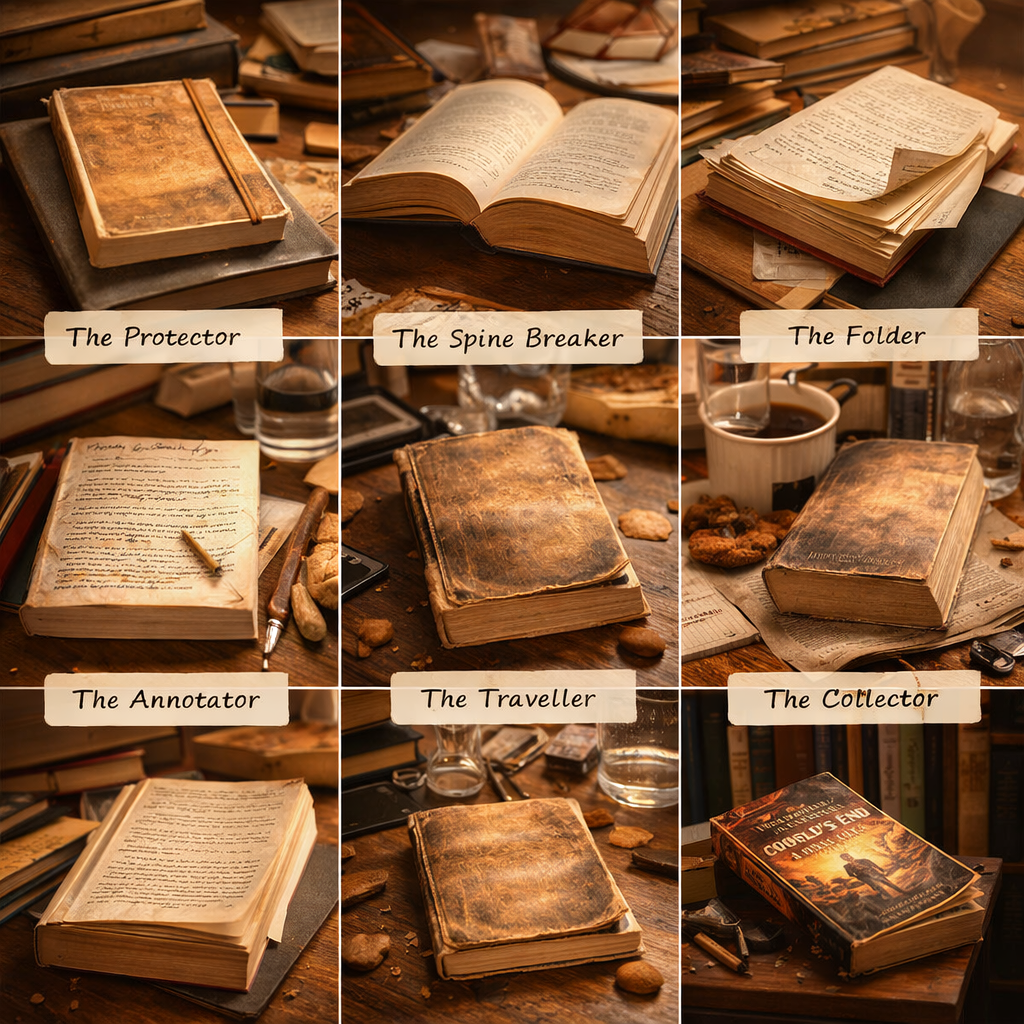
There are many ways to read a book. Some people approach a paperback with care, almost reverence. Others treat it as a temporary object—something to be used, bent, carried, and lived with.
And somewhere in between, dozens of small, strange habits say far more about us than we might like to admit.
Because the way you treat a paperback…is rarely just about the book. It’s about you.
The Protector
You know this person immediately. The book is opened gently, barely more than necessary. The spine remains unbroken. Pages are turned with care, as though they might object to anything rougher.
There are no creases. No marks. No signs of wear.
This reader believes books should be preserved—kept in the best possible condition, as close to new as time allows.
They likely:
Keep books away from food and drink
Use proper bookmarks
Store them neatly, upright, in safe environments
This is someone who values control. Order. Longevity.
They don’t just read stories. They protect them. And if they ever lend you a book…return it exactly as you received it.
The Spine Breaker
This reader wastes no time. The book is opened fully, confidently, with a soft crack that echoes through the room like a declaration. This is not carelessness. It’s commitment.
The Spine Breaker reads deeply and without hesitation. They want the book to feel comfortable in their hands, softened by use, shaped by experience.
Their books often:
Fall open to favourite pages
Show visible wear
Feel lived-in
This is someone who believes stories are meant to be experienced fully—not tiptoed around. They don’t preserve books. They inhabit them.
The Folder
This one is controversial. The Folder does not use bookmarks. They fold the corners of pages—small, deliberate creases marking their place.
To some, this is unacceptable. To others, it’s efficient. But for The Folder, it’s something more. It’s about leaving a mark. A quiet, physical sign that says: I was here.
Their books carry these moments throughout—little bends and corners that map out their reading journey. This is someone who values practicality over perfection. They move through stories quickly, leaving traces behind.
The Annotator
Pens. Highlighters. Notes in the margins. The Annotator doesn’t just read a book—they interact with it. They underline sentences. Circle words. Write thoughts in the spaces between paragraphs.
Their paperback becomes something else entirely:
Part book.
Part conversation.
This reader is engaged, curious, and often reflective. They want to understand, question, and respond. They are not afraid to change the book slightly…to make it their own.
The Traveller
This book has seen things. It’s been in bags, on trains, in cafés, on beaches. It’s been opened in different places, under different lights, in different moods.
As a result, it’s a little worn. The edges are softened. The cover might be slightly bent. There may be a stain that no one remembers. But this is not damage. This is history.
The Traveller reads whenever and wherever they can. The book is not an object to be protected—it’s a companion. Something that moves with them.
The Collector
This reader owns many books. They are arranged carefully, often beautifully. Spines aligned. Covers displayed. Each book is part of something larger—a collection that reflects taste, identity, and interest.
The Collector may or may not read everything they own. That’s not really the point.
Books are:
Objects of meaning
Markers of identity
Part of a personal landscape
This is someone who sees books as more than stories. They are symbols.
The Re-Reader
This paperback is not new. It has been read before. Possibly many times. It opens easily, naturally, to familiar sections. Certain pages feel different, as though they’ve been held longer than others.
The Re-Reader returns to stories. Not for novelty…but for comfort.
This is someone who finds value in repetition, in familiarity, in revisiting something that once mattered—and still does.
Their books are not just read. They are known.
The Careless One
Let’s be honest. We all know this person. The book is bent. Left open face-down. Thrown into bags without thought. Pages might be slightly wrinkled. Covers a little worse for wear.
It’s easy to judge. But this reader is not disrespectful. They simply see the book differently. To them, it’s not something fragile.
It’s something functional. Something to be used, enjoyed, and moved on from. And while their books may not last as long…their reading experience is often immediate, unfiltered, and free.
What Does It Actually Mean?
Of course, none of this is scientific. No one is entirely one type. Most of us move between them—depending on the book, the moment, the mood.
A new book might be treated carefully. An old favourite might be handled without hesitation. And sometimes, a story changes the way we interact with it entirely.
Where Conspiracy at World’s End Fits
Some books invite care. Others invite use. Conspiracy at World’s End sits somewhere in between. It’s a story about what remains…when everything else falls away. About the small things that endure.
And perhaps that’s why it works best as a paperback. Something you can hold. Carry. Return to. Something that, over time, might change slightly in your hands.
Not perfect. But yours.
Final Thought
The way you treat a paperback doesn’t just reflect how you read. It reflects how you move through the world.
Carefully.
Boldly.
Thoughtfully.
Freely.
There’s no right way.
Only your way. And maybe that’s the point. Some stories stay pristine. Others stay with you.
So, if you had to choose, which one are you?
Conspiracy at World’s End — available now on Amazon.
#ReadingHabits #BookLovers #PaperbackCulture #ReaderPersonality #IndieAuthor #ConspiracyatWorldsEnd #WritingLife #BookCommunity

Daz James
Promote published works, interact with readers, share updates.
© 2024. All rights reserved.